Following a Book Across Borders
Following a book across borders reveals how translation, rights, printing, and local discovery shape the edition a reader eventually finds.
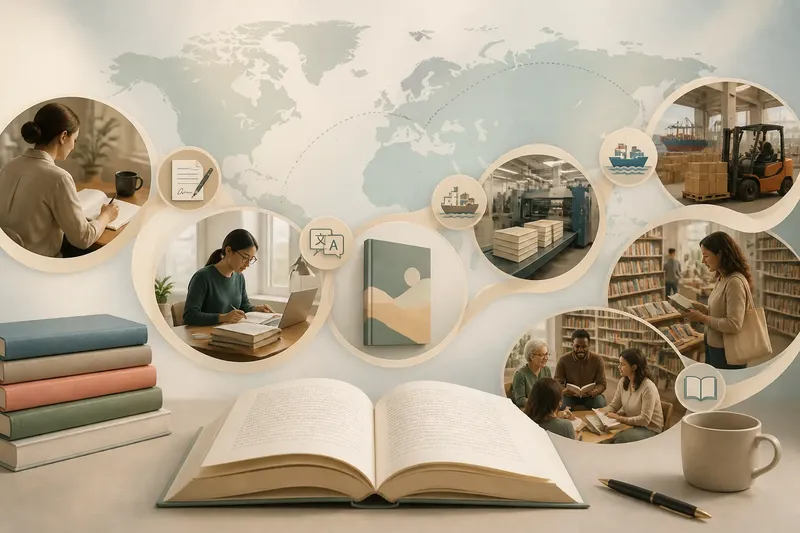
Following a book across borders means tracing a chain of decisions, not simply watching a parcel move. A manuscript written in one language may become a translated edition, acquire a new cover, pass through several distributors, and reach readers through a local bookstore or library. Each handoff changes what the book can be in its next place.
Start with the rights, not the shipping label
A publisher usually needs permission to issue a book in a new territory or language. Those permissions are described in a rights agreement: it may cover a particular language, format, or market, rather than every possible edition everywhere. A book can therefore have different publishers for its original language, a translation, an audiobook, or a regional edition.
The rights holder may be the author, an agent, or a publisher, depending on the agreement. Literary agents and rights teams often present books to publishers abroad through a rights catalogue or at a book fair. A foreign publisher considers whether the title suits its list, whether translation rights are available, and whether it can support editing, production, and sales in its market.
When you see a book listed in another language, check the publisher and edition details rather than assuming it is an identical reprint. The title, format, publication schedule, and credited contributors can all differ.
Translation carries choices as well as meaning
A translator works with more than dictionary equivalents. A joke, form of address, regional expression, or reference to a school system may have no direct counterpart. The translator has to preserve the author’s intent while making the prose intelligible and alive for readers who bring different cultural knowledge.
Editors may discuss a phrase with the translator, request revisions, or consult a specialist about a technical passage. The original author may be involved, but the process varies by contract and publisher. Translators are often credited on the cover or title page; their name is a useful clue when comparing editions.
Say you find a translated novel at a neighborhood bookshop and notice that its title differs from the one you know. The publisher’s description and translator credit can help you tell whether it is the same work under a locally chosen title or a different book with a similar name.
Production determines what can travel
Once a publisher has a text ready, it has to choose how to produce and supply the edition. A print run may be made near the publisher, printed in another country, or coordinated through a regional partner. Paper availability, printing capacity, shipping routes, and delivery schedules can influence that choice.
Books can also cross borders as digital files. An ebook may be licensed for certain territories, while a print edition moves through freight and customs before entering a local warehouse. A publisher or distributor selects the route; a reader typically encounters the result as a format, an estimated arrival, or an edition marked unavailable in their region.
For readers, the practical question is which edition is accessible and suitable. Check the language, format, publisher, and delivery options before ordering, especially when a listing combines details from multiple editions.
Distribution connects publishers to local shelves
A distributor helps move books from a publisher’s stock to booksellers, libraries, schools, or other buyers. In some markets, a publisher handles these relationships directly; in others, a local distributor provides sales contacts, warehouses, and ordering services. The arrangement affects how easily a shop can obtain a title, not just how far the book has traveled.
Importers may bring in editions published abroad, while local publishers may issue their own versions. Bookstores choose what to stock based on their customers, shelf space, and supplier arrangements. Libraries make separate collection decisions, sometimes using wholesalers or regional networks to acquire titles.
That means an edition’s absence from one shop does not necessarily mean it has no local readership. Ask a bookseller whether it can be ordered, or check a library catalogue for a different publisher, language, or format.
Local discovery gives a book its next life
A book reaches readers through more than availability. A local bookseller may recommend it, a librarian may place it in a display, a teacher may assign it, or a reading group may choose it. Reviews, festivals, community organizations, and social conversations can also introduce a translated work to readers who would not have searched for it directly.
These routes are shaped by local context. A publisher may adapt jacket copy or cover design, while a bookstore chooses how to describe the book to its own customers. Such choices can bring a work into view, but they can also frame it differently from the way its original publisher presented it.
When you discover a translated title, look beyond the cover blurb. The translator’s note, author biography, publisher page, and library catalogue may reveal how the edition was prepared and who helped bring it to readers.
What can readers check when an edition is hard to find?
Why does the same book have different titles?
A publisher may choose a title that reads naturally in the new language or signals the book’s subject to local readers. Compare the author, translator, and publisher details to confirm that two listings refer to the same work.
How can I tell who translated an edition?
Look at the cover, title page, copyright page, or publisher’s catalogue entry. If the listing omits the translator, search by the book’s title and publisher or ask a bookseller to check the edition record.
Why is a book unavailable in my country?
Rights may not have been sold for your territory, or a local edition may not yet be published or stocked. A bookseller or library can help identify whether another language or format is available to order.
Where should I look beyond a large bookstore?
Try an independent bookshop, a public or university library, or the publisher’s local catalogue. These sources may list small publishers and translated editions that are less visible in broad retail searches.
Follow the edition, not just the author
Following a book across borders becomes easier when you treat each edition as its own object. Note its language, translator, publisher, format, and territory; then check who distributes it and where local readers can encounter it. Those details turn a vague search for a distant title into a useful trail—and reveal the people and decisions that let a book travel.