Why the High Seas Need Shared Rules
Why the high seas need shared rules: understand what lies beyond national waters and how common principles help countries manage a shared, connected ocean.
The high seas need shared rules because no single country owns the waters beyond national jurisdiction, yet ships, fish, and pollution move through them every day. The phrase describes ocean areas outside the zones where a coastal state has sovereign rights or other authority under international law. They are not ungoverned empty space: vessels remain subject to rules, especially those of their flag state, and international agreements set common obligations.
To understand why those rules matter, follow one ordinary voyage from a coastal port toward open ocean. At each point, ask who can act, which rules apply, and what crosses a boundary. This simple route shows why freedom of access and shared responsibility must operate together.
Start by separating national waters from the high seas
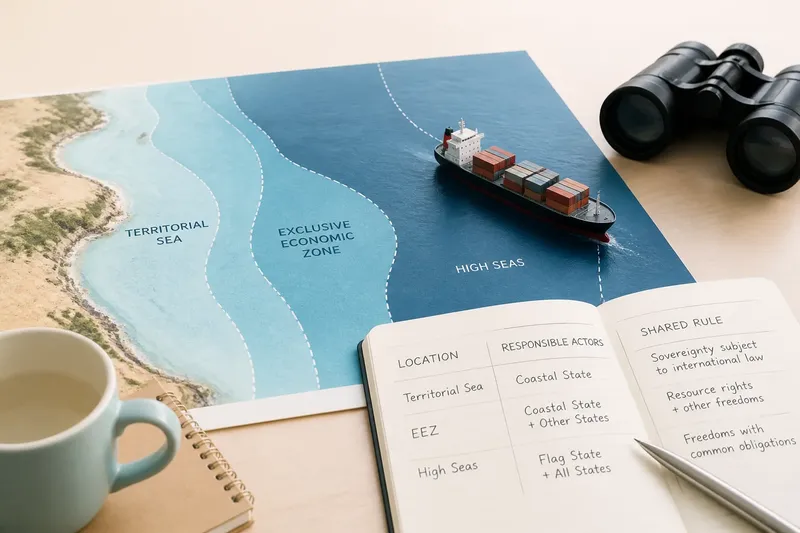
A coastal state has sovereignty over its territorial sea, subject to the rules of international law. Beyond it, the exclusive economic zone, or EEZ, gives that state specific rights over natural resources and certain related responsibilities; it is not the same as full territorial ownership. The high seas begin beyond the areas under national jurisdiction. Their exact location depends on the surrounding maritime boundaries, not on how far a ship feels from land.
This distinction matters because different rights apply in different places. In an EEZ, for example, the coastal state has rights concerning resources such as fish and seabed energy, while other states retain certain freedoms, including navigation, under international law. On the high seas, no coastal government can claim the water as its territory simply because it is nearby.
The ocean floor also requires a separate distinction. The seabed beyond national jurisdiction is called “the Area” in the law of the sea, and its legal framework is not identical to that governing the water above it. A reader following a deep-sea mining proposal should therefore check whether it concerns an area of national jurisdiction or the international seabed.
Follow a voyage through a changing set of responsibilities
Imagine a cargo vessel leaving a port in one country, passing through another state’s EEZ, and then reaching the high seas. The vessel carries a flag from a third country. On the high seas, its flag state has a central role in regulating and supervising the ship. Coastal states still have defined rights in their maritime zones, but the ship does not become the property of whichever country’s waters it passes through.
That arrangement supports navigation between countries, but it does not mean a vessel can disregard common obligations. Rules address issues such as safety at sea, pollution from ships, and the conservation of marine life. International agreements provide shared standards; national authorities put many of those standards into effect through their laws, inspections, and enforcement.
Think of the system as overlapping responsibilities, not a single ocean police force. The flag state, port state, coastal state, and relevant international bodies have different roles. Their authority depends on the location, the activity, and the applicable agreement.
Use a week to read the rules as a connected system
A short reading routine can make the legal map easier to follow. Use one issue throughout the week, such as a fishing vessel, a ship’s waste, or a proposed activity on the seabed. Keep a notebook with three columns: location, responsible actors, and shared rule. Add only what you can support from an official source.
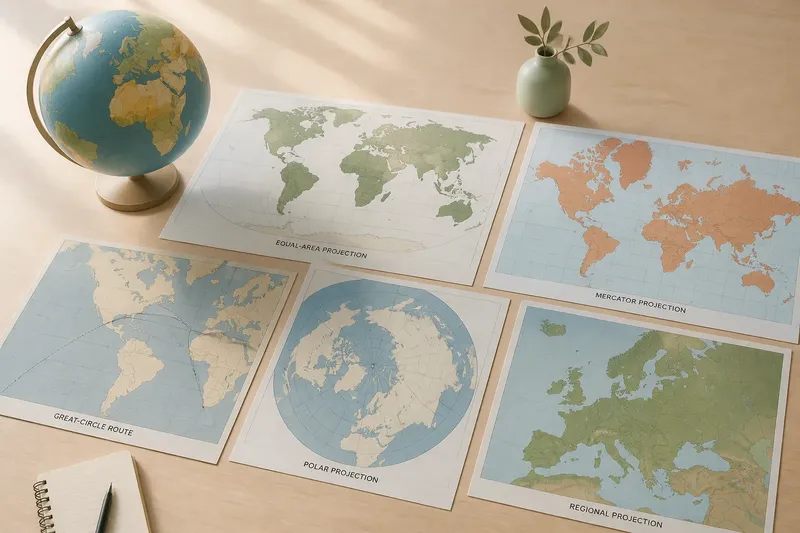
- Monday: Mark the location. Find a reliable maritime map and identify the coast, territorial sea, EEZ, and high seas relevant to the issue. Note that boundary claims can be disputed, so do not treat every map line as uncontested.
- Tuesday: Identify the activity. Describe what is happening in plain language. Fishing, commercial navigation, scientific research, and seabed mining can involve different rights and rules.
- Wednesday: Find the responsible state. For a vessel, look for its flag state and any port or coastal state with a relevant role. For an activity without a vessel, identify the country or organization proposing or authorizing it.
- Thursday: Locate the common standard. Consult the relevant treaty or an official explanation from an international organization. Check what the text actually covers instead of assuming that one agreement governs every ocean issue.
- Friday: Trace the practical link. Ask how the activity could affect other states, migratory species, or marine ecosystems beyond the immediate location. Record the pathway rather than assuming every consequence is known.
- Saturday: Check how rules are carried out. Look for the national authority responsible for implementation, along with any inspection, reporting, or cooperation mechanism described in the applicable framework.
- Sunday: Write a short account. Explain what is permitted, who has responsibilities, and what remains uncertain. Keep legal authority separate from a claim about whether a particular actor has complied.
Say you are following a report about a vessel fishing beyond a coastal state’s EEZ. Your notes show the vessel’s flag state, the relevant fisheries agreement, and the body that coordinates conservation measures. The resulting account can distinguish a shared conservation rule from the separate question of whether the vessel violated it.
Shared principles protect freedoms and set limits
High-seas freedoms allow states to use the ocean for activities such as navigation, subject to international law and the rights of others. These freedoms help keep distant routes open and support communication, trade, and scientific work. They are not a blanket permission to do anything anywhere.
Common principles establish boundaries around those freedoms. States have duties to cooperate on the conservation of living resources and to protect the marine environment. A country also has responsibilities for ships flying its flag. Those obligations matter because impacts can travel: pollution can drift, fish populations can move across jurisdictions, and harm to an ecosystem can affect people far from its source.
Shared rules also help prevent a “first mover” advantage from becoming the only practical rule. If each actor could take resources without regard to others, restraint by one state could leave it at a disadvantage while another exploited the same stock. Common standards give states a basis for coordinating limits, exchanging information, and challenging conduct through established channels.
Understand how international rules become practical
International rules do not enforce themselves. States negotiate agreements, accept obligations through their own legal processes, and create institutions or procedures to support cooperation. At sea, the flag state often has a direct compliance role for its vessels. Port states may inspect ships entering port under applicable rules, while coastal states exercise rights and responsibilities within their maritime zones.
Different issues have different arrangements. The International Maritime Organization develops global standards for shipping and marine pollution. Fisheries organizations can coordinate conservation measures for particular regions or species. The United Nations Convention on the Law of the Sea supplies a broad legal framework, while other agreements address specific activities or protections.
When a rule is broken, the response depends on the agreement, the location, the evidence, and the authority involved. Possible routes include national enforcement, reporting requirements, consultations between states, or procedures established under an agreement. Do not assume that a reported incident has already been legally resolved.
Which questions help explain the high seas?
Does anyone own the high seas?
No state owns the high seas as national territory. States and people may exercise activities allowed under international law, but those freedoms come with duties and limits.
Can a coastal state control every ship near its shore?
No. A coastal state has particular authority in its territorial sea and specific rights in its EEZ, but those zones do not give it blanket control over all ships nearby. The legal position depends on the maritime zone and the activity.
Who is responsible for a ship on the high seas?
The flag state has a central responsibility for ships registered under its flag, alongside the relevant international obligations. Other states may have roles in particular circumstances, such as when a ship enters port or when a specific treaty applies.
Are all high-seas activities governed by the same agreement?
No. The law of the sea provides a broad framework, while shipping, fishing, pollution, research, and seabed activities may also be covered by distinct agreements and institutions. Identify the activity before deciding which rules are relevant.
Read claims about the ocean with a location in mind
When a headline says that an activity took place “in international waters,” ask what that phrase means in the specific report. Does it refer to the high seas, an EEZ, or a loosely described area? Then check the activity, the state or organization responsible, and the agreement that may apply. Labels in news coverage can compress legal distinctions that change who has authority.
For claims about a particular vessel, compare the report with official information where available, such as a flag registry, a fisheries organization’s notice, or a statement from the relevant authority. Treat a missing detail as an open question, not evidence of wrongdoing. Where the issue turns on a disputed boundary or complex legal interpretation, consult qualified legal expertise or an authoritative source.
Why the high seas need shared rules becomes clearer when each voyage is read as a chain of responsibilities rather than a blank area between countries. Keep the map, the activity, and the applicable agreement together. That habit helps separate a genuine gap in governance from a place where authority is shared, limited, or still contested.